
Ironman Ottawa 2026: Redemption, Rain and the Pain Was Worth It

Updated: Sep 5
Why Ironman Ottawa?
The answer was simple. Coach Rachel and I wanted redemption.
After last year’s race, we both knew we were capable of much better. We had unfinished business, a score to settle and apparently a deep desire to spend another year swimming, biking and running unreasonable distances for fun.
Ironman Ottawa was our opportunity to return, put everything we had learned into practice and deliver the race we knew was hiding somewhere inside us.
Training
Patagonman was in early December for me, which meant taking a very small break before official Ironman Ottawa training began on January 1.
Coach Rachel also revived the brilliant and slightly unhinged idea that we should post a Strava activity every day of the entire year. That meant starting the RSR Get Moving Challenge and Ironman training at the same time.
Thankfully, one of those challenges is now finished. The other continues lurking in the shadows, demanding daily movement.
The cold winter months created a few challenges, but the weather was surprisingly cooperative and we rarely had to move sessions around. Then, at some point, Coach Rachel was asked to run the 10K Seaton Scramble.
Naturally, I said no.
Let’s do the 50K.
Because moderation has never been allowed anywhere near the RSR training calendar.
We adjusted our plan, added more running early in the schedule and prepared for our first ultramarathon. To our surprise, our bodies handled the extra distance extremely well. The training left us with a huge running base, so we took advantage of it and kept pushing our run fitness throughout the Ironman build.
That decision paid off in spades on race day.
As the temperatures finally began to climb, our rides gradually moved outside. Spring seemed to take approximately nine years to arrive, especially when we were staring down four and five hour indoor rides. There are only so many motivational videos you can watch before your bike trainer starts feeling like a hostage situation.
We had also hoped to do plenty of open water swimming, but Lake Ontario near our house refused to warm up until July. That left us with only a couple of races and a few open water swims before Ottawa. Unfortunately, the lack of open water practice would also make an appearance on race day.
Overall, we completed a massive amount of training. Our biggest week totalled more than 20 hours, with several others landing between 17 and 20 hours.
We had done the work. We were fit. We were ready.
At least that was what we kept telling ourselves.
Pre Race
Race morning began the way all race mornings begin: offensively early.
We were awake at 2:30 a.m. to eat our traditional breakfast of two packets of peaches and cream oatmeal, a banana and coffee. The pre race jitters were in full effect, and by 3:00 a.m. we were walking two kilometers through downtown Ottawa toward the race venue.
It was a surreal walk. We passed people ending their Saturday night while ours was just beginning.
They were heading home to bed.
We were heading out to exercise for the next 12 hours.
Life choices were definitely being made on both sides of the street.
At the venue, we met our friend Mark, who directed us toward the bag drop. From there, we boarded the shuttle bus to the swim start and first transition.
Ottawa uses split transitions, which adds another layer of logistics and stress. Personally, I think the extra planning is worth it. A different race format brings new challenges, and apparently I enjoy collecting those.
As soon as we stepped off the bus, we heard the race announcer deliver the news:
The swim was wetsuit optional.
My nerves immediately launched themselves into orbit.
I am not a Kona contender, but Coach Rachel had a longshot chance. We quickly discussed our options and decided, “The hell with it. We are doing this.”
We are both strong swimmers. We had completed 3.8 kilometers without wetsuits before, and we were not going to chicken out now.
Decision made.
Then we discovered that Coach Rachel’s front tire was flat.
Of course it was.
We used the spare tube from her bike, changed it, pumped everything up and hoped the tire gods were finally satisfied. I headed to the mechanics to find another tube so she would still have a spare during the race. Luckily, I was able to buy one and the crisis was resolved.
With the bikes ready, we found a patch of grass, drank some Gatorade, ate Honey Stinger chews and attempted to talk ourselves down from the nervous ledge.
Eventually, it was time to make our way to the swim start.
Coach Robert's Race
The Swim
As we waded into the water, Rachel and I shared one final hug and wished each other good luck.
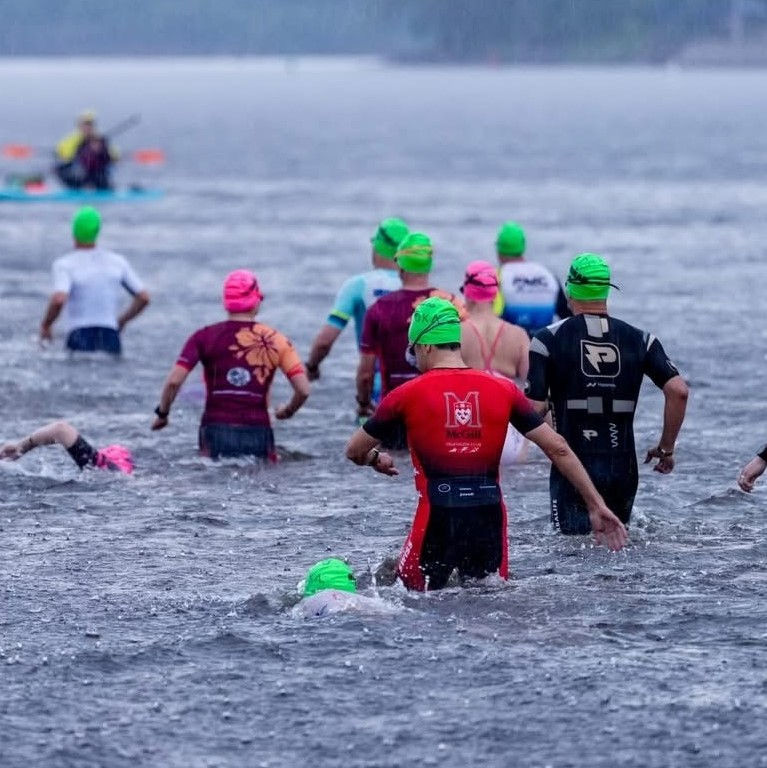
I looked at her and said, “I’m going.”
I started my watch, dolphin dove and immediately swam off course.
Excellent start.
I normally prefer the outside of the swim because there is less traffic. Without a wetsuit, I especially wanted to avoid being punched, kicked or used as a flotation device by several hundred of my closest triathlon friends.
Unfortunately, other swimmers had the same idea.
I kept moving farther outside until I realized I was getting much too far away from the course. In the grand scheme of things, it was not a huge mistake. I made a small adjustment and continued toward the first turn buoy.
At the turn, I once again tried to stay outside. This time, the rescue kayaks kept everyone inside a much narrower swimming lane than I expected. I was forced into traffic and eventually decided to cut gradually across the other swimmers toward the inside.
That finally gave me the open water I had been looking for.
By the time my watch vibrated at 1,500 meters, I had already used far more energy than planned. I slowed my kick to conserve energy, and the rest of the swim was relatively uneventful, aside from being swum over a few times by wetsuit swimmers who started behind me.
As I exited the water, I finally saw my numbers: 3,790 meters in 1:22.
The lack of open water practice had definitely shown up. I also probably slowed my kick much more than necessary. Either way, the swim was finished, and one of the greatest feelings during an Ironman is completing a discipline and realizing you do not need to do it again that day.
Transition was mostly uneventful, although slower than expected because I had to pee.
This will become a recurring theme.
The most surprising discovery was that Coach Rachel’s bike was already gone.
She had beaten me out of the water.
It was a very proud dad and coach moment, but it also meant I had work to do if I wanted to catch her.
The Bike
The bike was relatively uneventful, other than needing to pee twice. Apparently, in your 50s, you need to pee alot.
It was raining heavily, so I will let you fill in the blanks.
I did not stop.
I caught Rachel at approximately 10 kilometers. We briefly discussed the swim, exchanged our bike plans and then I continued down the road.
Ottawa is a relatively flat course, so our strategy was to keep the power reading on our Garmins in the high blue to low green range and see where that left us.
Rain had been falling on and off since the swim start, and it continued throughout the bike. With three loops and plenty of congestion, the course demanded constant attention. There were several crashes, riders passing extremely close and people passing cyclists who were already passing someone else.
It was 180 kilometers of keeping my head up and trying not to become part of someone else’s race report.

My nutrition plan was one bottle of Gatorade and two gels per hour. During the third and final hours, I switched to PH1000 and added peanut butter and jam sandwiches and Honey Stinger chews as needed.
This was my twentieth Ironman, and I think I finally nailed my bike nutrition.
It only took twenty attempts. We believe in persistence at Rapid Snail Racing.
By the end of the second loop, I was ready to get off the bike. Apparently, Rachel felt exactly the same way because the final time we passed each other, she yelled those exact words at me.
We had officially reached the “this bike has been fun, but I never want to see it again” portion of the day.
The Run
The run from the bike dismount line into transition was long, so I removed my cycling shoes and ran barefoot.
An amazing volunteer tried to encourage me to move faster.
I politely explained that I was going to take my time.
He was okay with that.
I put on my running shoes and hat and headed toward the course.
Wait.
I had to pee again.
Once that was handled, I finally started running.
The crowd support outside transition was incredible. Unfortunately, I am known for running much too fast at the beginning of a race, and the energy from the crowd sent me flying.
Once the crowds thinned at approximately 1.5 kilometers, I looked at my Garmin and discovered I was running at 5:00 per kilometer.

That was much too fast. My plan was to run no faster than 5:45 per kilometer.
I slowed down and tried to settle into my planned pace.
At least I thought I had settled in.
At approximately three kilometers, the course reaches a small rise. Let’s call it a small rise even though it is definitely not small when you have already swum 3.8 kilometers and ridden 180 kilometers.
The climb burned far more energy than expected, and I began feeling lightheaded. I quickly took a gel, knowing I was under fuelled, but the dizziness continued to get worse. There were visions of Coach Rachel in my head shaking her finger at me in disgust as my under fueling heading out of transition has happened many, many times in our training.
I had two gels remaining, originally planned for kilometers 10 and 15. At that moment, the options were to eat them or potentially end up on the ground.
I ate them.
During the first loop, I supplemented with plenty of chips, orange wedges and a couple of Maurten gels from the aid stations.
I had arrived with a fire in me to run a four hour marathon, and through the first 15 kilometers, I thought it might still be possible.
Around that point, I saw Rachel. I was near 15 kilometers, and she was approaching nine. We exchanged a few quick words but did not stop for a hug. We were both deep into our races and not ready to break our rhythm.
At approximately 19 kilometers, I did the math and realized that even with a strong second half, I was probably looking at a 4:15 marathon.
My motivation took a small hit, but special needs was approaching and I expected to see our support crew. Seeing them always provides a boost, and I also wanted to hand over my sunglasses and heart rate strap. The strap had begun chafing badly, because apparently running a marathon was not uncomfortable enough on its own.
I entered the special needs area, but our crew was nowhere to be seen.
There was nothing to do except keep moving.
That was when the torrential downpour began.
The rain immediately brought back memories of Ironman Maryland 2024, when the king tide arrived and parts of the run course ended up under water.
People congratulated us for continuing to run through the storm, but between you and the rest of the internet, I loved it. The rain kept my body temperature down, and although I was soaked, I was never cold.
Shortly after the torrential downpour began, I had to pee again. Every porta potty was occupied, and I was already completely soaked from the rain. At that point, I made an executive race day decision and just let it go. Nobody would notice, right? This was no longer rain. It was nature’s camouflage. Somewhere around the second loop of an Ironman marathon, dignity quietly leaves the course without telling anyone.
The second loop placed me firmly aboard the struggle bus. It was a bumpy ride, the air conditioning was broken and apparently there were no scheduled stops.
This was where all the 50K training paid off.
I walked more than I wanted, but it was minimal compared with the 25 to 30 kilometers I had walked during last year’s race. My legs were tired, but they kept moving.
As I rounded the final corner, I held my head high. My smile grew, and the pain briefly faded when the finish line came into view.
Eleven hours, 41 minutes and 52 seconds after I started, I was done.
It was my fastest Ironman in years and probably the best race I have ever executed. The gastrointestinal problems that had destroyed previous races never appeared. In fact, there were moments when I was genuinely hungry and searching the aid stations for food like a raccoon investigating an unattended garbage bin.
Redemption Delivered
We returned to Ottawa because we wanted redemption.
We believed we could perform better than we had the year before, and we showed up prepared to prove it. The race was not perfect. There were swim mistakes, flat tires, heavy rain, repeated bathroom requirements, some unexpected dizziness and a lengthy ride on the struggle bus.
But we stayed in the race, managed the problems and kept moving forward.
Today, speed was optional.
I went for it anyway because fitness is mandatory, and thankfully, I brought plenty of it along for the ride.
Coach Rachel's Race
The Swim
The swim was unexpectedly wetsuit optional. My dad and I talked it over and decided to go for it without our wetsuits.
We are both strong swimmers and had completed the distance without wetsuits before. Still, starting an Ironman swim without that extra buoyancy added another layer of nerves to an already stressful morning.

As tradition now seems to dictate, I threw up during the swim.
At this point, it might simply be part of my race strategy. Some athletes sight every six strokes. Apparently, I throw up and then continue swimming.
Once that little ritual was complete, I settled back into my rhythm and kept moving forward. I stayed composed, focused on my stroke and eventually reached the swim exit in 1:18:29.
When I arrived at my bike, I realized something was wrong.
My dad’s (Coach Robert) bike was still there.
I had beaten him out of the water.
My first thought was, “Oh my God, did he die?”
It was clearly the only reasonable explanation.
Thankfully, I spotted him on the bike course not long afterward and realized that he was completely fine. I am just that dramatic, and apparently I had put together a very strong swim.
The Bike
The bike felt strong.
There were a few aches and uncomfortable moments, but nothing unusual for an Ironman. After several hours in the same position, your body begins submitting formal complaints about your decisions.
Despite the discomfort, I stayed focused and continued moving well. I managed my effort, kept the pedals turning and worked through each section of the course.
Eventually, my dad caught me. It was reassuring to see that he had not, in fact, died during the swim.
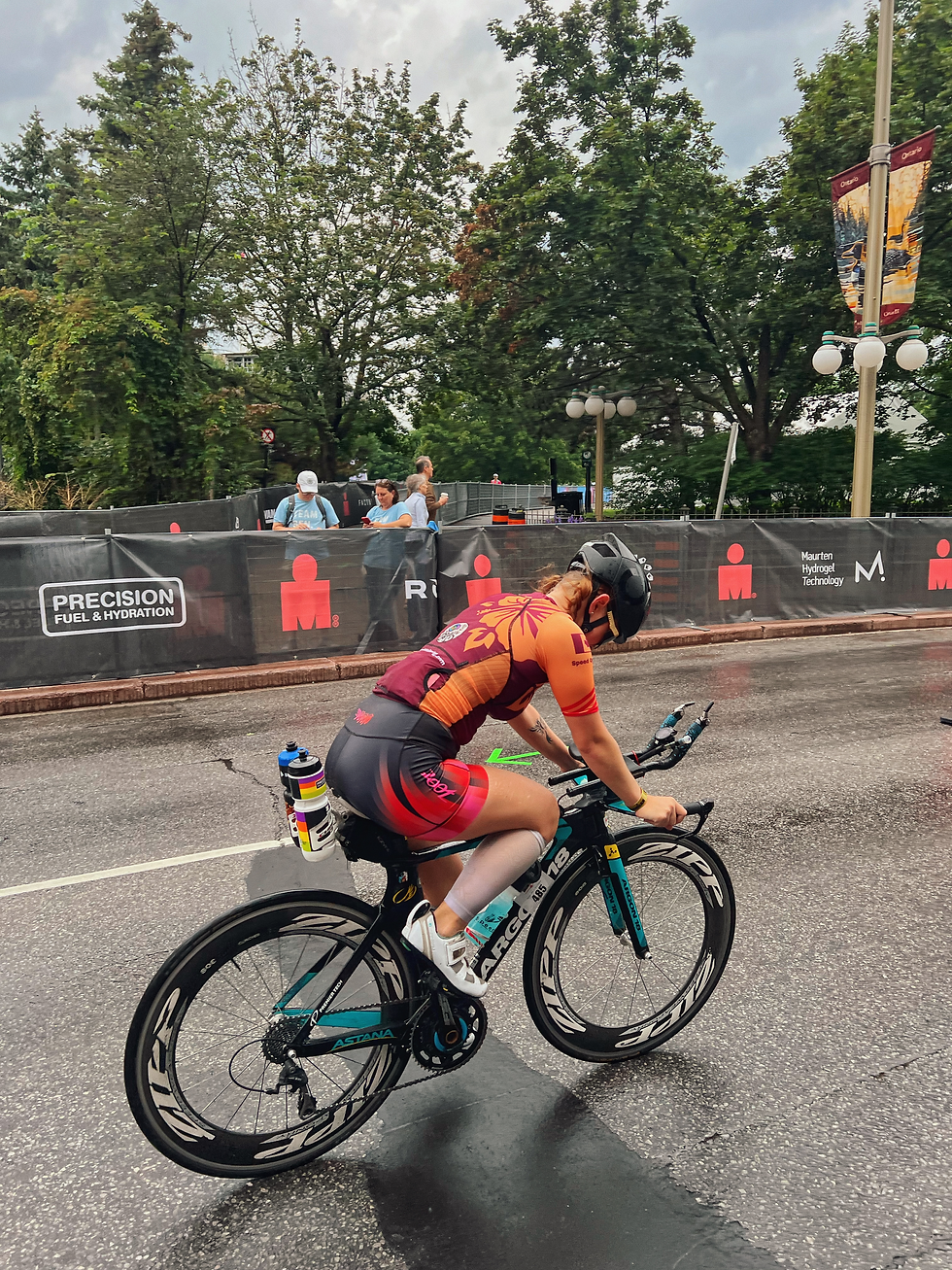
More importantly, I took approximately 15 minutes off my bike split from last year.
That was a win I was more than happy to accept.
The bike was not perfect, but it was faster, stronger and better managed than the year before. That was exactly what I had returned to Ottawa to accomplish.
After 180 kilometers, I was extremely ready to give my bike to a volunteer and begin the marathon.
I may have even announced this loudly to my dad when we passed each other.
The Run
The run surprised me the most.
After the swim and bike, I expected the marathon to become difficult early. Instead, I stayed composed and continued moving forward.
The kilometers slowly disappeared behind me. I managed the discomfort, focused on what I could control and remained surprisingly steady deep into the marathon.
Maybe I was too deep in the zone. Maybe I was becoming slightly dehydrated. But at one point, I could have sworn I watched another racer reach into the back of their shorts, retrieve what appeared to be a piece of chocolate and casually toss it into the garbage.
Was it actually chocolate?
I chose not to investigate.
Did it actually happen?
Only that racer, the garbage bin and my possibly dehydrated extremely fatigued race day brain know the truth.
This is the side of endurance racing nobody puts in the promotional videos. At Rapid Snail Racing, however, we believe honesty is mandatory, even when something absolutely cannot be unseen.
Whenever things became difficult, I repeated one simple phrase:
“The pain is worth it.”

Every early alarm was worth it.
Every difficult workout was worth it.
Every moment I questioned why I was doing this was worth it.
I stayed composed all the way to kilometer 37 before things really began to unravel. At that point, there were only five kilometers remaining, although Ironman kilometers are approximately seventeen times longer than normal kilometers.
The wheels were beginning to fall off, but thankfully only metaphorically this time.
Even as the race became harder, I reminded myself that I had already accomplished what I had returned to Ottawa to do. I was stronger than I had been one year earlier. I was having a better race, and I had already beaten last year’s version of myself.
I did not need to be perfect.
I only needed to keep moving.
One kilometer at a time, I made my way toward the finish line and completed the marathon in 4:38:20.
Redemption Delivered
When I crossed the finish line, I had my redemption.
The race was not painless or perfect. I threw up during the swim, spent part of transition wondering whether my dad had died and reached the final kilometers of the marathon with everything beginning to unravel.
But I was better.
My bike split was approximately 15 minutes faster than last year. I stayed composed until kilometer 37 of the marathon, bringing my run under five hours and finished in 12 hours, 18 minutes and 50 seconds. That's a PB by just over an hour and a half.
I returned to Ottawa to beat the athlete I had been one year earlier.
That was exactly what I did.
Every early morning, every tired leg and every difficult training session led to that finish line.
The pain was worth it.
Which makes me wonder, Just how fast can i go?
Redemption in the Rain
If you have made it this far, congratulations. You have officially suffered through the entire race report with us. We suffered for 3.8 kilometres of swimming, 180 kilometres of biking and 42.2 kilometres of running, so it only seemed fair that you suffer through all the words before getting the good stuff. As your reward, here is the Ironman Ottawa 2026 documentary. Sit back, grab a snack and enjoy the chaos. You have earned it. Probably.
Speed Optional. Redemption Mandatory.

Ready to chase your own Ironman finish? Explore our personalized endurance coaching or training plans and let Rapid Snail Racing help you reach the start line prepared, confident and ready for the chaos.


Comments